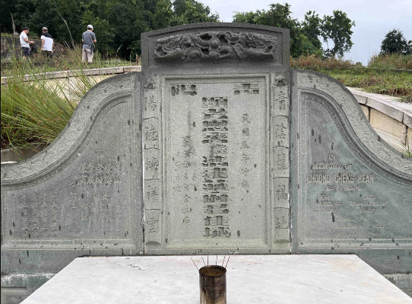
Merchant, Revenue Farmer, Rice Miller, Rubber Planter. Born in Tong’an district, Fujian Province, was one of the most important Chinese merchants in Kedah during the late 19th and early 20th centuries. His close connections with the Sultan of Kedah, the Malay elite, and the Chinese merchant community in both Kedah and Penang made him a key figure in the region's economic history. Initially migrating to Tongkah in the 1870s as a teenager, Choong later moved to Kedah where he worked as a grocery shop assistant. After being dismissed, he worked as a gardener for the Raja Muda of Kedah, who encouraged him to start his own grocery business and even provided initial capital. Choong's business prospered, leading him to join the Penang opium syndicate and eventually monopolize Kedah's opium farm from the late 1880s until 1909.
Choong expanded his business to include various revenue farms such as opium and spirit, gambling, pawnbroking, customs, ferry, and the export duties on tin and tapioca, extending his influence from Kedah to Penang and southern Thailand. Towards the end of the 19th century, he moved his residence to Penang, where his family became an integral part of the merchant community. Choong was married to several women, including Yeoh Khuan Neoh, Lim Gek Kee Neoh (his principal wife), Lim Gaik Teen Neoh, and Ong Ee Gaik Neoh, and had two sons, Lye Hock and Lye Hin, who carried on the family business after his death in 1916.
Around 1900, Choong permanently relocated to Penang, and with the phasing out of the revenue farm system, he transitioned into rice milling and rubber planting. His sons, Lye Hock and Lye Hin, expanded the family business under Hock Hin Brothers Ltd., owning a chain of successful rice mills across Penang, Kedah, and Perak by the 1930s. In the 1960s, the third generation of the family, further diversified into the real estate sector, becoming influential in Penang's property market.
Reference/ Further Reading
Loh Wei Leng et al., eds. 2013. Biographical Dictionary of Mercantile Personalities of Penang. Penang and Kuala Lumpur: Think City and MBRAS.
Wu, Xiao-An. 2010. Chinese Business in the Making of a Malay State, 1882-1941: Kedah and Penang. Singapore: NUS Press.